

Published: May 14, 2026
Written by Ingrid Udd Sundvor.
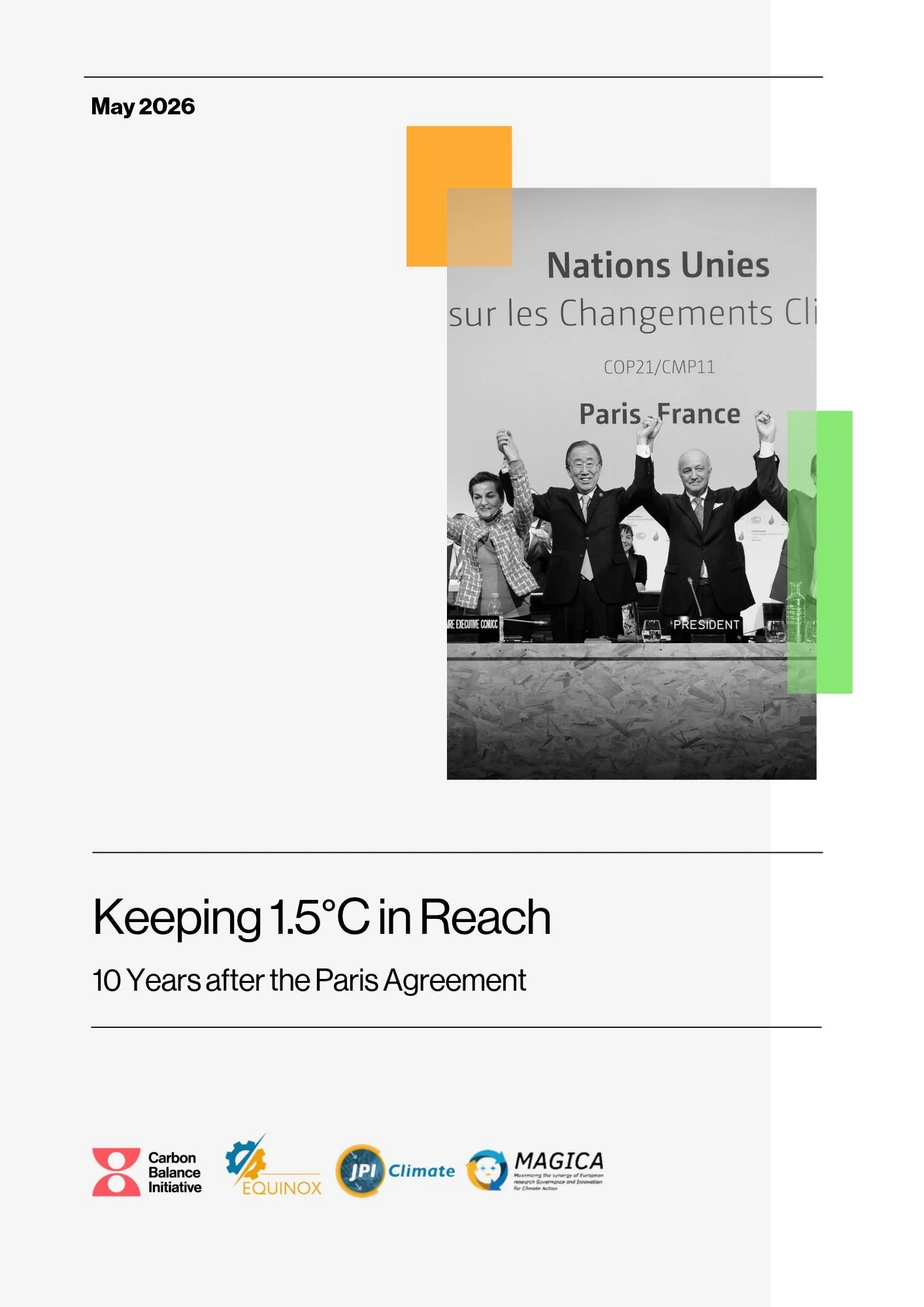
Ten years after the Paris Agreement was adopted, climate policy is entering a new phase. This report brings together insights from the Equinox Workshop, convened by JPI Climate in Brussels in February 2026, where experts working between science and policy assessed what it will now take to keep 1.5°C in reach.
Drawing on the latest scenarios and Earth System science, the report looks at four questions: how pathways to 1.5°C have shifted, what a genuine balance between emissions and removals means in physical terms, how much carbon dioxide removal will be needed, and how temperature overshoot should be governed. It sets out what policymakers need to understand to build climate strategies that are credible and aligned with the science.
Download the full report
Key Findings Include:
1.5°C without overshoot is no longer attainable. Updated scenarios put the lowest possible peak warming at around 1.7°C. Bringing warming back to 1.5°C by 2100 would need carbon dioxide removal at a very large scale.
Deep emissions cuts remain the priority. Limiting warming to near 1.5°C requires cutting greenhouse gas emissions by around 60% by 2035 and 80 to 90% by 2050, compared with 2019. Fossil fuel use must also fall rapidly and steeply.
Stopping warming requires a like-for-like balance. Every tonne of fossil CO2 must be matched by a tonne stored in geological timescale storage, referred to as geological net zero. A new indicator, net geological carbon intensity, offers a transparent way for countries to track their progress towards it.
Natural carbon sinks are weakening, and accounting overstates progress. Over the past decade, climate change has reduced the land carbon sink by around 25% and ocean uptake by around 7%. Estimates of land emissions differ by roughly 9 GtCO2 a year between national inventories and global models. That gap makes countries' progress look better than it is.
Carbon removal falls far short of what's needed. Global carbon removal is around 2.2 GtCO2 a year, almost all of it land-based. Novel methods deliver just 0.002 GtCO2, compared with fossil emissions of 36.8 GtCO2 in 2023.
Overshoot is a "second-best world", not a substitute for action. No country yet has legal or regulatory frameworks for net-negative emissions. Existing "polluter pays" tools were designed to cut emissions, not to require removals. New governance mechanisms will be needed to share responsibility fairly between countries and sectors.
Read the report to get up to speed on the latest scientific findings shaping climate policy ten years after the Paris Agreement.