

ExxonMobil brings second challenge to Article 23
Rachel Ardiff
Introduction
Last month ExxonMobil announced a notice of arbitration against the European Commission for the carbon storage obligation created under Article 23 of the Net Zero Industry Act (NZIA). The US energy giant is bringing a claim under the Energy Charter Treaty (ECT) – a legal treaty designed to protect foreign investors in the energy sector.
ExxonMobil has filed this dispute through subsidiaries in Belgium, Luxembourg and the UK. The notice is undergoing a ‘cooling-off period’, a mandatory waiting period typically lasting 3-6 months implemented to encourage parties to potentially reach an agreement, before the company can formally file an arbitration claim.
This dispute is in addition to the legal challenges the storage obligation faces in EU law through the General Court of the European Union, brought last year by 12 obligated entities against the Commission. This blog will explore the implications of the investment arbitration claim against the Union’s first ever carbon storage mandate.
ExxonMobil
ExxonMobil has a 50% or more ownership stake in five of the entities obligated under Article 23.[1] These five entities have a collective obligation of 8.89 Mtpa, responsible for nearly 18% of the EU’s 50 Mtpa by 2030 carbon storage goal. The energy conglomerate is well known globally for its litigious nature towards any perceived threats to its business model and has been involved with litigation with its own shareholders, states, NGOs, foreign governments, counter-suits against those bringing litigation as well as market competitors. Not all obligated entities are able to bring disputes as ExxonMobil is. In order to bring a claim under the ECT, you must be an international investor who has been disproportionately affected by regulations imposed by a foreign government hosting an energy project. In the case of Article 23, some obligated entities are wholly owned by domestic companies or companies situated outside the ECT and therefore do not qualify to bring an ECT claim. Others may be able to bring disputes in theory, but do not have the resources or desire to become embroiled in what is sure to be a long and drawn-out dispute on uncertain legal ground.
Arbitration
The Energy Charter Treaty (ECT) is an international treaty designed to protect international investments and foreign investors from unfair treatment by governments hosting energy projects, in particular defending against unfair or arbitrary regulation and expropriation. Investor-State Dispute Settlements (ISDS) is the enforcement mechanism, allowing investors to bring claims against states through arbitration, rather than domestic courts. ISDS processes file claims for financial compensation rather than a strike-down of the policy or regulation in question.
The vast majority of large energy projects globally contain an arbitration clause which allows international investors to bring claims against government actions that (they argue) interferes with their investments’ profitability, both in fossil and renewable energy contexts. The ISDS process has historically attracted criticism from civil society groups for prioritising commercial interests over States’ ability to create public interest regulation, particularly in the context of climate and environmental policy. The threat of investment arbitration has been said to have a chilling effect on the creation of fossil fuel phase-out policies globally.
The European Union and the Energy Charter Treaty
The EU announced its withdrawal from the ECT in 2024, citing incompatibility with the bloc’s climate goals, in particular the EU Green Deal and the Paris Agreement, but a built-in 20-year sunset clause means it remains bound by the ECT’s terms until 2044. Several member states had already withdrawn from the ECT at that point, citing similar concerns.[2]
In general, investment arbitration has come under fire for the vast sums that international conglomerates demand from states in response to climate-related regulation – money that critics argue would be better spent accelerating the energy transition itself. There are a few notable examples that have attracted widespread criticism. These include the German company RWE requesting €1.4bn in compensation from the Netherlands for their coal phase-out by 2030 plan, British oil-refining company Klesch Group suing the EU, Germany and Denmark for at least €95m in compensation for the windfall tax introduced during the 2022 energy crisis and British oil and gas company Rockhopper, bringing a case against the Italian government for refusing to grant a production concession for an oil field in the Adriatic Sea. In the Rockhopper case, the refusal of concession followed the reintroduction of coastal drilling bans for environmental and public safety concerns in Italy. Rockhopper was initially granted €250m in compensation, including interest, despite an initial investment of only €29.2m. Although the panel which granted the claim later came under review, the case was considered indicative of the repercussions that states could face when attempting to usher in the energy transition.
A study by Investigate Europe in 2021 found that the total value of infrastructure protected by the ECT in Europe, including Switzerland and the UK, was €344.6 bn, the equivalent of two years of EU Commission expenditure.
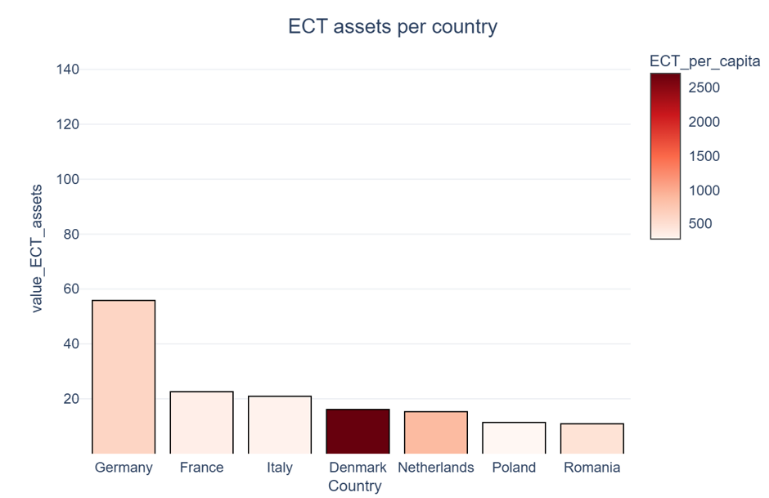
The Member States with the largest ECT-protected assets each have obligated entities under Article 23.
However, in a 2021 case Komstroy, the Court of Justice of the EU ruled that for intra-EU disputes, investor-arbitration under the ECT is incompatible with EU law. The Court found that for a Member State to hand over large amounts of financial compensation to an investor from another Member State has the potential to have distortive effects on the single market and therefore is not permittable. In practice, this means that although a company or investor based in the EU can still bring a claim, the relevant Member State cannot legally pay said financial compensation even if the panel finds that they were in breach under EU law. In fact, German company RWE ultimately withdrew the €1.4bn claim against the Netherlands for their coal phase-out plan, as they found they were not able to bring an intra-EU dispute.
Although this ruling was expected to, and has, deterred other intra-EU ISDS disputes, ExxonMobil has not been dissuaded, having filed a case against the Dutch government through its Belgian subsidiary, three years after the Komstroy ruling. Both Shell and ExxonMobil are bringing a case against the shut-down of the Groningen gas field in 2024 through Nederlandse Aardolie Maatschappij B.V (NAM), a company jointly owned by the energy giants, and the entity with the largest obligation under Article 23.
These developments could have important implications for the notice filed against Article 23 by Belgian, Luxembourgish and UK-based companies. The Belgian and Luxembourgish entities may face legal constraints as a result, but the UK-based entity is not bound by the same restrictions. That could make it an easier route for the energy giant to seek financial compensation from the EU Commission.
The Future of the Challenge
Although the arguments that ExxonMobil intends to make are not publicly accessible, ECT disputes tend to rely on two related but distinct claims: a breach of fair and equitable treatment by the state (Article 10(1)), and expropriation (Article 13). Fair and equitable treatment covers transparency, regulatory stability, protection of legitimate expectations, and predictability of state conduct, while expropriation covers the deprivation of an investor’s property or profitability without sufficient compensation. An arbitration panel will need to weigh these claims against the state’s right to regulate. States are allowed to regulate in the public interest, provided it is done so in a non-discriminatory and proportionate manner, without that regulation triggering a claim for compensation.
Two recent cases, both concerning fossil fuel investors challenging the regulation of fracking, show this balance playing out: in Ascent Resources v Slovenia, the tribunal’s July 2026 award unanimously dismissed all €598.7 million of Ascent’s claims over Slovenia’s fracking ban. Earlier, in Lone Pine Resources v Canada, the tribunal found no expropriation in Quebec’s moratorium on fracking, stating that simply changing regulation does not breach an investor’s legitimate expectation. This applies particularly where a change in regulation could be reasonably foreseen. The recent cases suggest a tribunal will consider both the intent of Article 23 and the context of its creation when assessing the dispute, considering whether the legislation is proportionate to its goal of building a functional domestic CO2 storage market and reaching the EU’s net zero targets – something we have argued previously that Article 23 does.
Any legitimate expectations claim also sit awkwardly against ExxonMobil’s own record, as it has been among the most vocal industry proponents of CCS and of market-based mechanisms to expand it. Unlike a fracking ban, Article 23 does not prevent Exxon from producing or selling products. Rather, compliance requires bringing more storage capacity online, for a service where demand is expected to significantly outstrip supply for years to come, creating mid- to long-term profits for the obligated entities. If the tribunal finds for ExxonMobil and the EU is required to financially compensate the company, the CO2 storage obligation will remain in place, though the EU has the option to rescind ExxonMobil’s obligation to avoid potential financial liability.
It leaves an open question worth asking as the cooling-off period runs its course at the end of October if Article 23 is not preventing Exxon from operating or profiting, and is in fact creating a market for a service it is well placed to sell, what exactly is the company asking to be compensated for?
ExxonMobil seemingly anticipated a CCS market in the EU built on public subsidies; instead it is required to invest in its own infrastructure to contribute towards the EU’s carbon management targets and decarbonisation goals. It has responded by pursuing numerous legal avenues in order to stop the legislation: an outcome we do not expect the claims to achieve.
Footnotes
[1] Nederlandse Aardolie Maatschappij B.V. (50% joint ownership), Oldenburgische Erdölgesellschaft mbH (OEG) (66% joint ownership), BEB Erdgas und Erdöl (50% ownership), Mobil-Erdgas (100% ownership), ExxonNetherlands (50% ownership)
[2] Including Poland, Spain, the Netherlands, France, Slovenia, Germany, Luxembourg, Belgium, Portugal and Denmark https://legalblogs.wolterskluwer.com/arbitration-blog/the-end-is-near-the-european-commissions-proposed-coordinated-withdrawal-from-the-ect